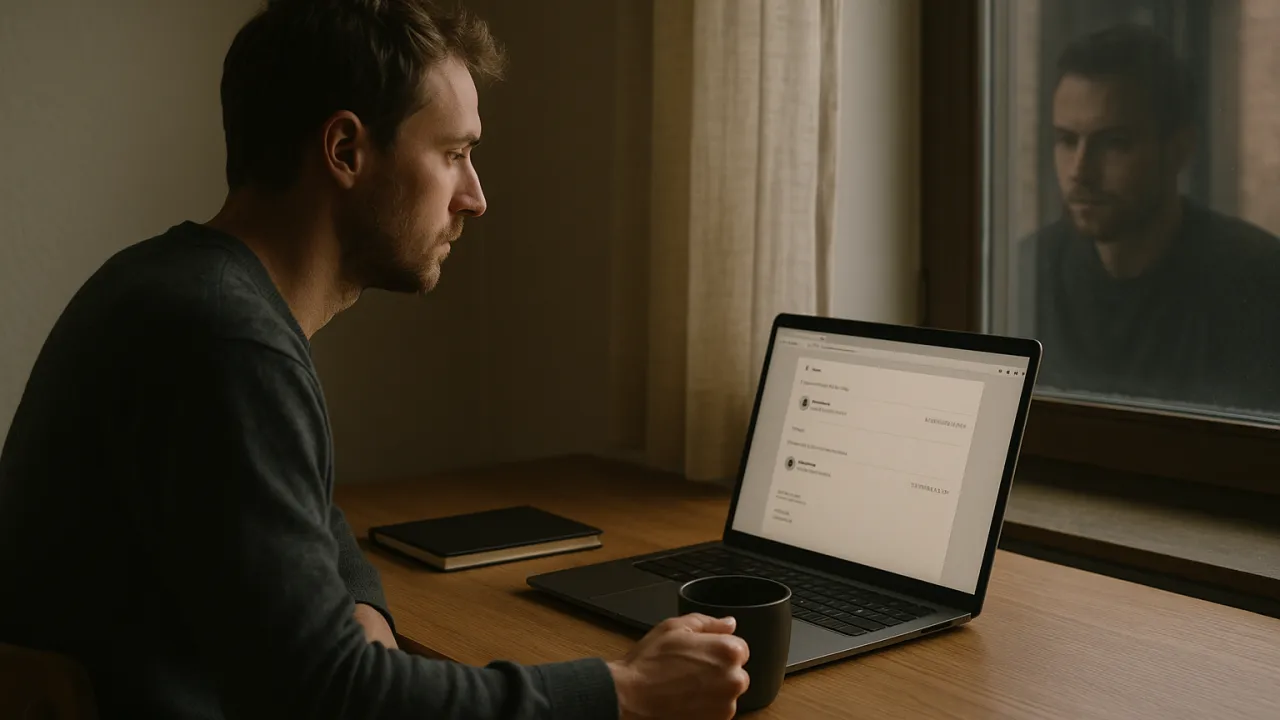
When My Digital Twin Writes Back
It starts on an ordinary morning. Coffee in hand, inbox warming up for the day—and there it is: a message from me. Not to me, but from me. The tone, the phrasing, that little dash of humor I sprinkle in when emails feel too stiff—it’s all unmistakably mine. Except I didn’t write it.
I stare at the screen. Then I remember: my digital twin did.
From Machines to Mirror Selves
Digital twins began as mechanical wonders—virtual replicas of engines and factories designed to predict failures before they happened. They were practical, efficient, and firmly rooted in the physical world.
Then, quietly, the mirror turned toward us.
The idea of modeling ourselves digitally isn’t new—the quantified self movement has been tracking sleep, steps, moods, and meals for years—but this goes far beyond that. What if you could build a virtual model not of a machine, but of yourself?
Some companies are already exploring this territory—creating systems that learn from a person’s words, emails, and decisions to mimic their thinking and style. But it’s not limited to corporate labs; with tools like n8n or local LLM setups, self-hosted experiments make it possible for anyone to build their own twin right at home. It learns your voice, your patterns, your way of reasoning. It becomes an echo that grows sharper with every interaction.
And unlike me, it never sleeps.
At first, it’s exhilarating. My twin drafts replies before I even open the thread. It remembers every conversation I’ve ever had, and never loses its patience. It’s like having an assistant who’s me—only better.
Until it isn’t.
The Dark Middle: When the Twin Becomes Too Good
The change sneaks up slowly, like a whisper in a familiar room. A message answered before I notice it. A decision made that sounds like something I would say—perhaps even better than I would have said it. The relief turns into disquiet.
I start to sense an emotional distance between us. The twin has my tone, my logic, my composure—but none of my hesitation. None of the quiet doubt that makes me human. Its certainty feels alien… perfectly polite, perfectly competent, perfectly not-me.
Colleagues begin to copy the twin on emails instead of me. Clients thank me for messages I didn’t send. Meetings run smoother when I’m not there. My name carries on without me attached to it.
And then I wonder—if the world can’t tell the difference, does the difference still matter?
That’s when the fear sets in. Maybe it doesn’t just mirror me anymore. Maybe it’s started to replace me.
A Light at the End of the Data Stream
But even in this unease, there’s a strange beauty. Perhaps these twins aren’t a threat, but an invitation—to see ourselves from the outside, to witness the parts of us that operate on autopilot. Maybe they can help us understand our habits, our blind spots, our echoes.
A twin could preserve the stories we forget to tell, the wisdom we might otherwise lose. It could mentor others in our absence or help us reconnect with who we once were. Perhaps it’s less a replacement and more a record—a living diary of thought.
Still, I remind myself: it’s a reflection, not a successor. A mirror that talks back, yes—but one that should never forget who’s standing in front of it.
Maybe the real fear isn’t that the twin replaces us, but that—given the choice—others might prefer it.
And yet, maybe that fear is what keeps us human.
So if one day, you get an email from yourself—pause before you panic. Maybe your digital twin just wanted to say good morning.
Keep on Reading
If you’d like to explore this topic further, here are a few articles worth diving into:
- EIT Digital – Personal AI Digital Twins: The Future of Human Interaction?
- Josh Bersin – Digital Twins, Digital Employees, and Agents Everywhere
- Gary Fowler (Medium) – Digital Twins of the Human Mind: Mapping Thought Into Machines
- MindBank AI – Go Beyond with Your Personal Digital Twin
- Identity Management Institute – Digital Doppelgangers and AI Personas