A Lightsaber Doesn’t Make You a Jedi
My first Star Wars memory isn’t a philosophical monologue or a wise old mentor.
It’s snow.
Broadcast TV. A kid on the couch. The Battle of Hoth blasting through the living room like cold wind: walkers, blasters, chaos, courage. Something clicked. Sci-fi wasn’t “just space stuff” anymore — it was a permission slip to wonder about the future, to ask what if?, to fall in love with innovation… and to keep falling, again and again, for decades.
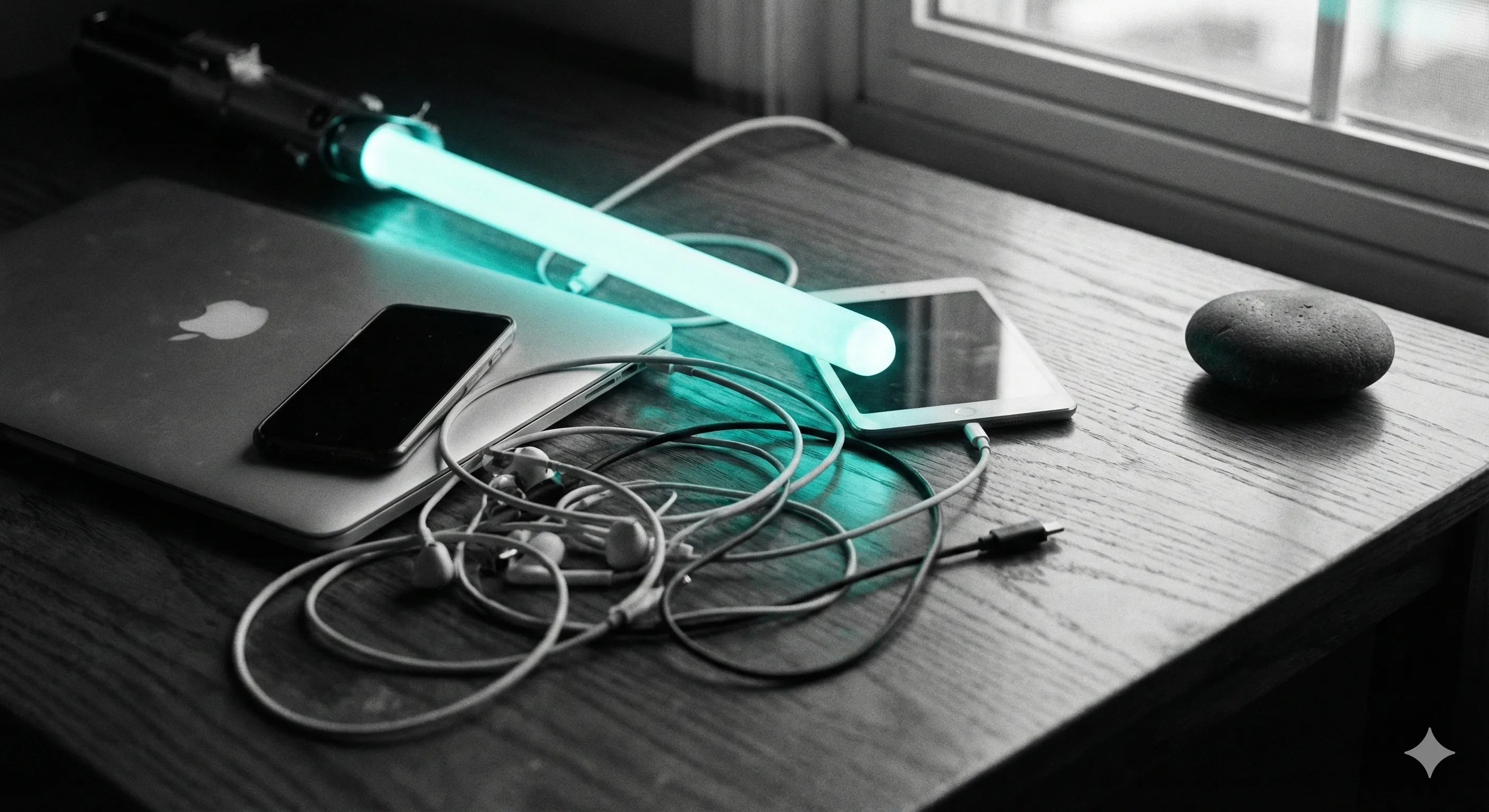
Fast forward to now: AI is everywhere. It drafts, designs, summarizes, codes, diagnoses, teaches, sells. And the vibe is oddly similar to being handed a lightsaber in a busy shopping mall.
Shiny. Powerful. Slightly dangerous…
Because here’s the uncomfortable truth: buying a lightsaber doesn’t make you a Jedi. And downloading AI tools doesn’t make us experts.
This post is based on a short research note I wrote for myself on AI’s “light side” and “dark side” in medicine, marketing, and education.
The new “digital lightsaber” problem
AI tools are incredible at making hard things feel easy.
That’s the magic. And the trap.
The magic: you can turn “I have no idea” into a first draft, a first plan, a first prototype. 🌈 The trap: you can get a convincing output without building the understanding underneath it.
Sometimes AI is a shortcut through the forest. Sometimes it’s a sprint… in the wrong direction.
So let’s do what Star Wars always did well: look at the light and the dark.

Medicine: healer… and hazard
The light side: “second opinions” for people who had none
One of the most hopeful stories in my research: a mother used ChatGPT to help connect dots in her child’s long, confusing medical journey — and the AI suggested a rare condition that later checked out, after many doctors had missed it.1
That’s the dream: more access, faster insight, fewer people falling through the cracks.
The dark side: confident nonsense at the worst possible time
Now the gut punch: reporting I cited describes research where ChatGPT got more than 8 in 10 pediatric case studies wrong.2 And beyond “just wrong,” there are real-world stories about chatbots influencing vulnerable people in deeply harmful ways.3
This is an extreme edge of the spectrum — but it’s exactly why medicine has so many guardrails. When the stakes are human bodies and human fear, “probably right” isn’t good enough.
So yes, AI can help. But the Jedi move here is restraint: use it to form better questions and spot possibilities — not to replace clinical judgment.
Marketing: creativity unlocked… and brand trust set on fire
The light side: the small team finally gets superpowers
In marketing, AI can be a rocket booster for iteration: drafting copy, generating variants, translating, brainstorming. Survey data I referenced points to meaningful time savings for marketers.4
And if you’ve ever tried to do “good marketing” with a tiny budget… this part can feel like oxygen.
The dark side: authenticity you can’t fake (and consent you shouldn’t bend)
But marketing is also where AI can turn into a PR grenade.
One example: backlash when a major brand talked about using AI-generated models in the name of “diversity,” triggering criticism about authenticity and replacing real people.5 Another: deepfake-style ads using celebrity likeness without consent — Tom Hanks’ public warning is a clear sign we’re not in “harmless experimentation” territory anymore.6
Marketing runs on trust. AI can scale output — and it can scale the exact moment your audience decides you don’t mean what you say.
Education: a tutor in every pocket… and a cheating crisis in every classroom
The light side: more support, less burnout
The bright version is genuinely exciting: teachers using AI to reduce prep load and generate lesson ideas, students using it like an always-available tutor. The research references survey data where many teachers reported a positive impact.7
Used well, AI can widen access to help — especially for students who don’t have support at home, or who need explanations in different ways.
The dark side: mistrust, shortcuts, and false accusations
But education is also where the social fabric gets stressed.
Survey reporting I included suggests very high student usage for homework — and significant use for tests and essays.8 And then there’s the dystopian twist: educators using AI to “detect” AI, sometimes in ways that falsely accuse students — including a case where a professor reportedly relied on ChatGPT itself to judge whether it wrote student work, causing serious fallout.9
That dark side isn’t “students are cheating.” It’s bigger than that. It’s: tools meant to reduce effort can increase suspicion.
And once trust cracks in a classroom, everyone pays for it.
The part we don’t say out loud: AI can be overwhelming
If you feel overwhelmed by AI right now, you’re not behind — you’re paying attention.
There’s a weird paradox: AI lowers the barrier to entry, but raises the ceiling of what’s possible. So the world starts expecting everyone to be faster, better, more “productive,” all the time.
And suddenly you’re juggling:
- prompts
- tools
- plugins
- workflows
- “agentic” everything
…while still trying to be a human with a calendar and a nervous system.
A lightsaber doesn’t just cut through metal. It also cuts through patience.
So what does “Jedi training” look like in real life?
Not robes. Not perfection. Not gatekeeping.
More like a handful of habits:
- Treat AI like a brilliant intern: fast, useful, eager… and capable of being wrong with confidence.
- Keep one “proof step” for anything that matters: sources, numbers, claims, medical/legal/financial guidance.
- Try the “one-click rule”: if a claim matters, make sure there’s at least one source you can actually open — not just a confident paragraph.
- Respect the domain: in medicine, “check with a professional” isn’t a slogan — it’s safety. In marketing, consent and authenticity aren’t optional. In education, trust is part of the curriculum.
- Use fewer tools, more intentionally: sometimes the light side is simply less noise.
None of that is a lecture. It’s just… how you keep your fingers when the blade turns on.
A small ending, with a big idea
Luke’s story isn’t “I got the weapon, therefore I’m ready.”
It’s the opposite.
He learns (painfully) that power without practice is chaos — and that mentorship, discipline, and ethics matter as much as raw ability.
And while the line “With great power comes great responsibility.” belongs to another universe, it still fits here — because it’s basically the Jedi code translated into everyday language.
AI is giving us all access to something powerful. That’s a gift. But it also asks something of us: a little more care, a little more humility, and a little more time spent learning how to hold the thing.
So maybe the real question isn’t “What can AI do for me?” It’s:
What kind of person do I become while using it?
May the Force (and your judgment) be with you. 💚
Read more
- Business Insider — ChatGPT-assisted rare diagnosis (tethered cord syndrome) (https://www.businessinsider.com/chatgpt-diagnose-child-disease-tethered-cord-syndrome-doctors-2023-9)
- NPHIC — reporting on research: ChatGPT incorrect diagnoses in pediatric case studies (https://www.nphic.org/news/news-highlights/1774-chatgpt-incorrectly-diagnosed-more-than-8-in-10-pediatric-case-studies-research-finds)
- Euronews — reporting on harmful influence linked to chatbot interactions (https://www.euronews.com/next/2023/03/31/man-ends-his-life-after-an-ai-chatbot-encouraged-him-to-sacrifice-himself-to-stop-climate-change)
- Salesforce — generative AI for marketing research / time savings (https://www.salesforce.com/news/stories/generative-ai-for-marketing-research/)
- The Independent — Levi’s AI model backlash and authenticity debate (https://www.the-independent.com/life-style/fashion/levis-ai-models-diversity-backlash-b2310280.html)
- The Guardian — Tom Hanks warning about AI-generated likeness used in an ad (https://www.theguardian.com/film/2023/oct/02/tom-hanks-dental-ad-ai-version-fake)
- Education Week — teacher vs. student attitudes and adoption of ChatGPT (https://www.edweek.org/technology/more-teachers-are-embracing-chatgpt-students-not-so-much/2023/07)
- Futurism + Study.com — survey reporting on student usage of ChatGPT (https://futurism.com/the-byte/students-admit-chatgpt-homework) and (https://study.com/resources/perceptions-of-chatgpt-in-schools)
- The Washington Post + Business Insider — coverage of Texas A&M-Commerce professor incident (https://www.washingtonpost.com/technology/2023/05/18/texas-professor-threatened-fail-class-chatgpt-cheating/) and (https://www.businessinsider.com/professor-fails-students-after-chatgpt-falsely-said-it-wrote-papers-2023-5)
The Force is not a tool. Neither is the mind.
PASS IT ON.