
There’s a comic I keep coming back to: xkcd’s classic on “Is it worth the time?”. It’s a little chart showing how much time you can spend building an automation before it stops being worth the effort, depending on how often you repeat the task.
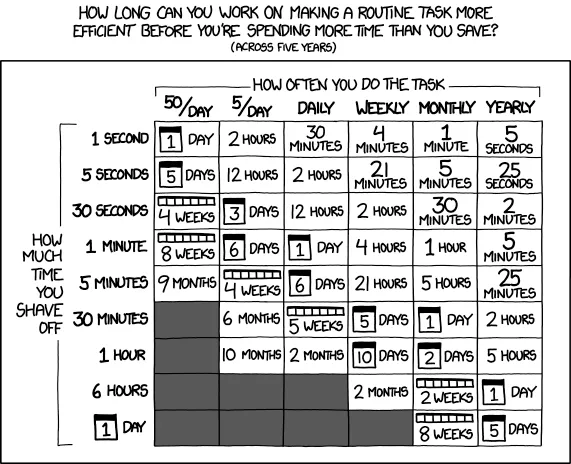
I used to glance at it with a sigh, because the punchline was usually: “Nope, don’t bother, you’ll never save that much time.” But lately? The math feels… broken. Or at least tilted. It’s as if the payoff curve has shifted so much that automating almost always feels worth it.
And yes, AI plays a starring role. But if we reduce the whole story to “Copilot writes my boilerplate now,” we miss the bigger picture. There’s a whole ecosystem at work, making automation not only faster to create but easier to justify.
AI at Your Fingertips
Generative AI has become the teammate who never gets tired of the boring bits: suggesting functions, catching bugs, writing the scaffolding.
GitHub even measured it: developers using Copilot finished tasks 55% faster than those coding unaided. That’s not a marginal bump — it’s the difference between spending your whole afternoon hacking at boilerplate versus finishing before your coffee gets cold.
The real shift here isn’t just speed, though. It’s confidence. When you know you can offload half the repetitive work, you’re much more willing to invest a few minutes in wiring up a script or small automation. The “friction” of starting has dropped close to zero.
Lego-Block Open Source
Once upon a time, automating a process meant writing most of it yourself — parsing data, logging events, retrying failures, reinventing wheels that never rolled straight. Now? Someone else has already built it, documented it, and uploaded it.
Open-source libraries have turned into a kind of shared memory bank for developers. Want to generate a PDF? Parse a CSV? Connect to an obscure API? Odds are there’s a package for it. Even better, it’s been stress-tested in the wild, so you inherit other people’s bug fixes and optimizations.
That means when you hit a repetitive task, the question isn’t if you can automate it, but which library gets you there fastest. The path of least resistance leads straight to automation.
Low-Code for the Rest of Us
Not everyone who wants to automate is a developer. And increasingly, they don’t need to be.
Low-code and no-code platforms have cracked automation open for anyone with curiosity and a bit of persistence. With drag-and-drop interfaces, pre-built connectors, and visual workflows, a marketing lead or finance analyst can design a working solution in an afternoon.
Gartner predicts that by 2026, three-quarters of new apps will be built this way. That’s an enormous cultural shift: automation has jumped the fence from IT into every corner of the business. If the person closest to the problem can also build the fix, the payoff curve tilts even further toward “worth it.”
Cloud & Serverless Magic
Infrastructure used to be the silent killer of automation ideas. You could build the script, but then came the harder part: finding a machine to run it, keeping it online, patching, monitoring, scaling…
Cloud and serverless flipped that script. Today you can spin up an environment in seconds, deploy a function that runs only when triggered, and forget about it until the next time it’s needed. You pay for execution time in cents, not servers in racks.
That ease has removed a whole class of excuses. Instead of “I’d love to automate this, but IT will never approve the server,” it’s: “Sure, I’ll throw it in a Lambda and call it a day.” Automation moved from headache to background hum.
Hardware That Can Keep Up
Even if the tools exist, they need horsepower behind them. Ten years ago, some automations were technically possible but practically useless — your laptop would wheeze, or the cost of compute would outstrip the benefit.
Now, specialized chips (GPUs, TPUs) and AI-ready machines make running complex workflows locally almost trivial. Deloitte projects the generative AI chip market will top $50B in the coming years. Vendors are already shipping AI-embedded PCs designed to handle model inference on the fly.
The practical upshot? Automations that once needed cloud supercomputers can now run quietly on your desk — faster, cheaper, and more private. Hardware isn’t the limiter anymore; it’s the enabler.
Back to the Comic
So what happens if we update that xkcd curve?
Tasks haven’t changed. We still file reports, format data, move files, integrate systems. But the time to automate those tasks has collapsed. More and more dots fall into the “worth it” zone.
That’s why automation no longer feels like a nerd’s guilty pleasure. It’s becoming the default.
A Gentle Takeaway
If you catch yourself wondering “is it worth it?” — the answer is increasingly yes. Not because AI alone has tipped the scales, but because everything around it — the open-source libraries, the low-code platforms, the cloud, the hardware — has shifted in the same direction.
The tools are there. The only question left is which parts of our work (and life) we want to automate — and which are better left delightfully human.
MAKE YOUR CASE.