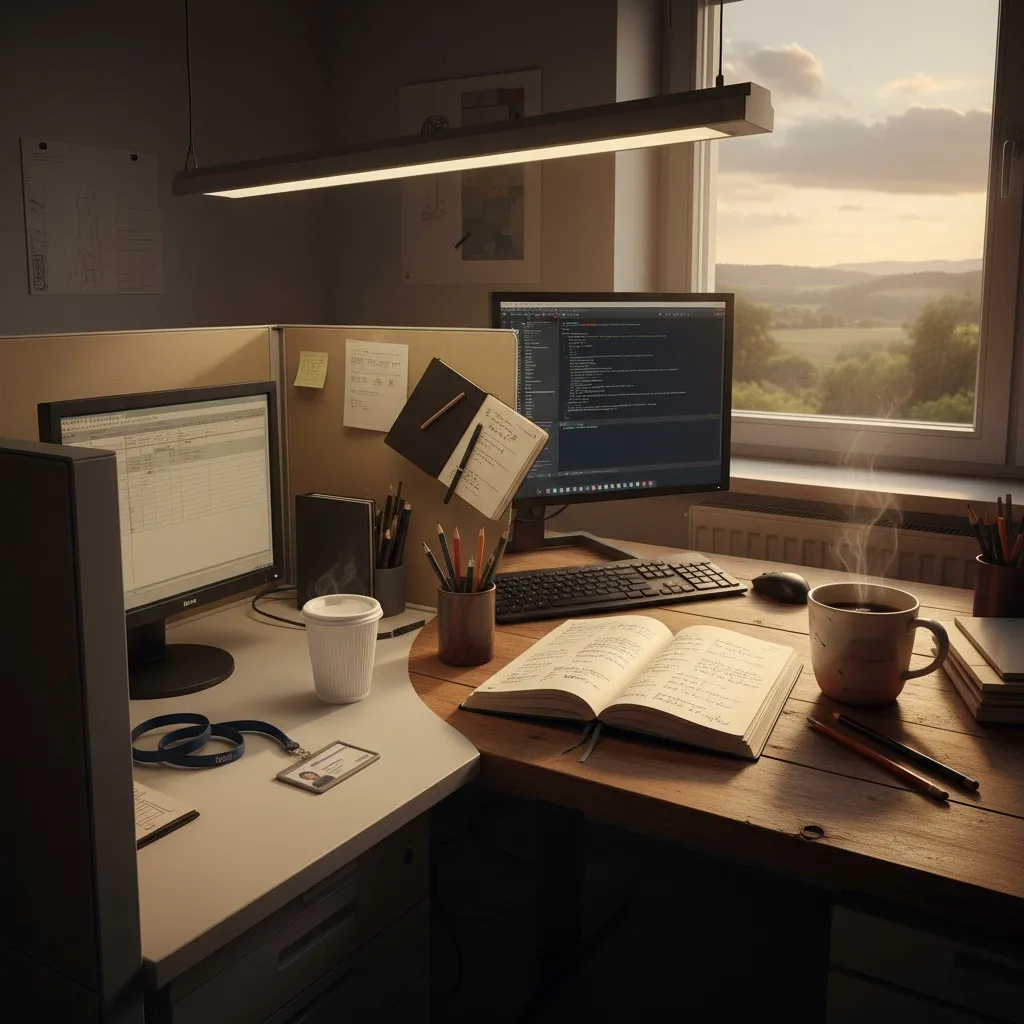
Two desks, same person.
The first one was white laminate. It came with the job — along with the badge, the lanyard, the open-plan hum, and a disposable coffee cup I replaced every morning without thinking. The chair was ergonomic. The monitor was fine. Everything was fine.
I sat at that desk for years. And at some point, I stopped noticing the fluorescent lights.
That’s the part that scared me. Not the lights themselves — they were just lights. It was the not-noticing. The way an entire sensory environment had become invisible. The way I’d optimised myself into a shape that fit the furniture.
The second desk
The desk I sit at now is wood. Real wood — scratched, coffee-stained, with dog hair in places I’ll never fully clean. There’s a ceramic mug instead of a paper cup. A notebook I actually write in. The monitor shows a terminal more often than a pivot table.
And through the window: Brandenburg. Rolling green, quiet mornings, the kind of sky that makes you forget you’re an hour from Berlin.
This desk wasn’t part of a plan. I didn’t have a five-year strategy or a launch date. There was no “excited to announce.” Just a slow, stubborn process of rearranging the objects in my life until they started feeling like mine.
What actually changed
Here’s what people get wrong about the corporate-to-independent story: they think it’s about leaving. The dramatic exit. The “I quit” moment. The phoenix rising from the ashes.
It wasn’t like that. Not for me.
The real shift was quieter. It was about ownership — and I don’t mean the startup equity kind. I mean the “this is actually mine to shape” kind. The problems. The decisions. The morning rhythm. The way I spend Tuesday afternoons.
I still do deep product work. I still sit in architecture conversations, navigate the messy middle of building things that matter, make decisions that affect real users and real teams. The work didn’t change. The relationship to the work changed.
Remote work gets talked about as a location thing — “work from anywhere.” But the real gift isn’t the where. It’s the how much you own. When you’re trusted with autonomy, when the people you work with care about outcomes more than hours logged, something shifts. You stop performing productivity and start actually being productive.
The space between
I’d be lying if I said both desks don’t still exist at the same time.
Some mornings I catch myself in the old posture — the slight hunch, the reflexive email-checking, the fluorescent-light mode where you optimise for visibility instead of value. The corporate desk isn’t a place. It’s a pattern. And patterns don’t disappear just because you change your address.
But the wooden desk is a pattern too. And it’s one I chose.
There’s a pencil holder that used to be a jam jar. Two dogs underneath — Fimme stretched out across my feet, Sien curled up on the rug behind me. The morning light hits the notebook around nine. By ten, I’ve usually written something I mean.
These aren’t productivity hacks. They’re the tiny, quiet details of a workspace that belongs to someone. To me.
Permission
The hardest part wasn’t the logistics. It wasn’t finding clients, or setting up the consultancy, or learning German tax law (though that last one came close). The hardest part was giving myself permission.
Permission to work differently. Permission to trust my own rhythm. Permission to believe that a desk in Brandenburg, with dog hair and coffee stains and a window that looks out over nothing important, could be the place where serious work happens.
We wait for permission a lot, I think. From managers, from markets, from some imagined version of professional legitimacy. We wait for someone to tell us that the way we want to work is valid.
No one tells you. You just start.
The desk you’re sitting at
If your workspace still feels borrowed — if the chair is ergonomic but the decisions aren’t yours, if the coffee is free but the mornings aren’t — maybe the question isn’t whether to leave.
Maybe the question is: what would a desk that’s actually yours look like?
Not the fantasy version. Not the Instagram-ready minimalist setup. The real one. With the stains and the mess and the dogs and the light that comes in at the wrong angle but somehow makes everything better.
The phoenix isn’t always fire and drama. Sometimes it’s just a better desk, better light, and permission to do your best work. 🌈
MAKE YOUR CASE.