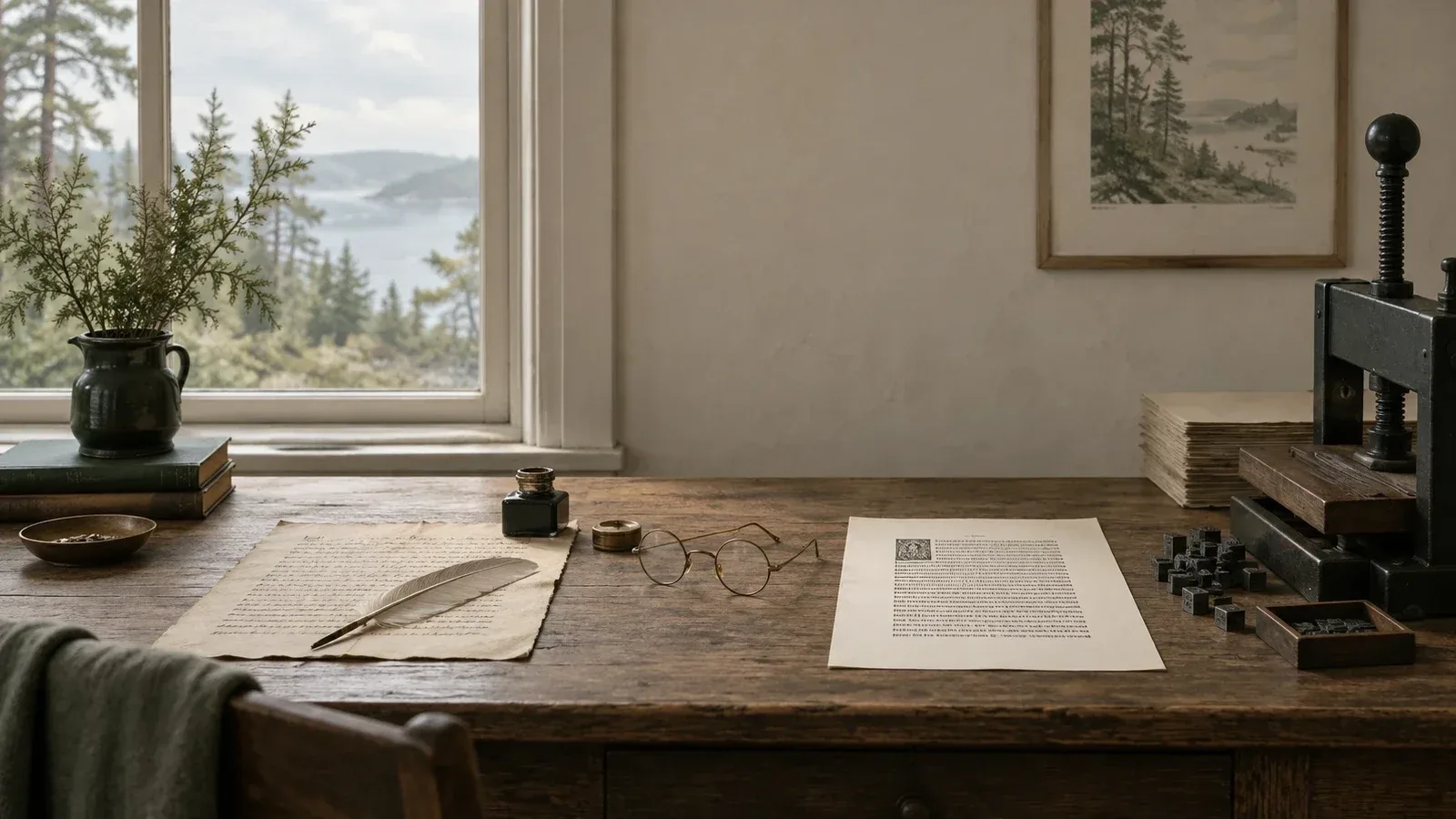
I keep coming back to a German abbot from 1492.
Johannes Trithemius ran the Benedictine abbey of Sponheim, near Bad Kreuznach. That year, at the request of a fellow abbot, he wrote a short treatise called De laude scriptorum, In Praise of Scribes. Its seventh chapter is titled “That monks should not stop copying because of the invention of printing”, and he doesn’t hold back. A monk who asks why he should bother copying by hand, now that print makes a whole library cheap, “only tries to conceal his own laziness”. Parchment lasts a thousand years, Trithemius wrote; a paper book, two hundred at most.
Two years later, in 1494, he had it printed. Peter von Friedberg set it in type in Mainz, so the praise of handwriting could circulate as widely as possible. A copy of that printed edition is still on offer at a German antiquarian dealer, some 530 years on (sorry, Johannes).
I used to read that as plain hypocrisy. I’ve changed my mind, and I’ll get to why at the end. For now he’s a good way into a pattern I keep seeing in companies, and that AI is speeding up a lot right now. A new tool folds several jobs into one person. That person gets real power. And a check that someone else used to do stops happening, usually without anyone deciding it should.

The scriptorium
For most of the Middle Ages, the monasteries were Europe’s copying machine. A book went through a chain of hands: someone prepared the parchment, scribes copied, a rubricator added the red headings, an illuminator painted the pictures, and a corrector checked the copy against its source. It was slow, expensive work, and the result was one book.
Gutenberg’s workshop in Mainz finished its Bible around 1455, in a run of 158 or 180 copies, depending on the source. A small team with a press now did what used to take whole scriptoria, and knowledge got a lot cheaper in a few decades. That’s the power part.
The risk part took a while to show. A scribe’s slip ended up in one book; a printer’s slip ended up in every copy. In 1631 the king’s printers in London, Robert Barker and Martin Lucas, left one word out of the Ten Commandments, and their Bible told its readers “Thou shalt commit adultery”. They were fined 300 pounds and most of the run was destroyed. The press multiplied the mistakes along with the books.
The typing pool
Jump forward to the middle of the last century. Big offices had typing pools, rooms of typists turning dictation and scribbled drafts into clean letters, and secretaries who kept the diary, booked the travel and decided which calls got through. An executive’s words passed through two or three people before they went out.
Then came word processors, PCs on every desk, email, online booking and slide software. Today most executives I work with write their own mail, book their own trains and build their own decks at eleven at night (I’ve done my share of those).
Did it free up their time? I’m not sure it did. Each task got faster, but now they all sit on the same desk, next to the job that person was actually hired for. And with the typing pool went the second reader, the person who noticed the date was wrong, or that the tone was a bit sharp, or that maybe you shouldn’t send that one today.
The spreadsheet
In October 1979 Dan Bricklin and Bob Frankston’s VisiCalc came out for the Apple II, the first spreadsheet for a personal computer. Lotus 1-2-3 and later Excel put it on every office desk. Work that used to keep a room of clerks busy, adding columns and re-running projections by hand, became something one analyst could do in an afternoon. One person could model a whole business, change an assumption and see the result in seconds.
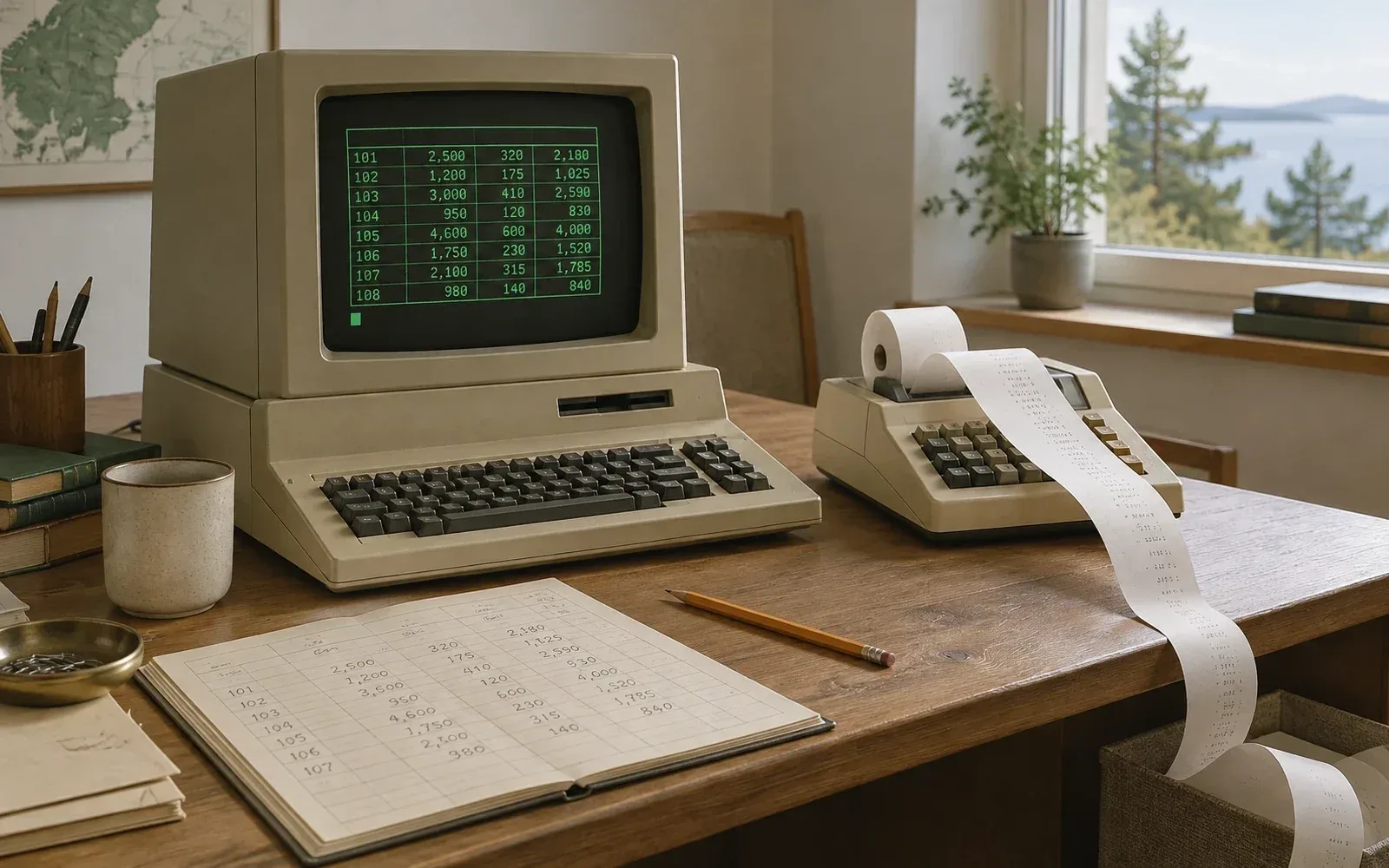
The risk shows up best in one case. In 2012 JPMorgan’s Chief Investment Office in London lost about 6.2 billion dollars on a credit derivatives position, the trades that earned one of its traders the nickname ‘the London Whale’. The bank’s own task force went through what happened, and one of the things it looked at was a new risk model. That model “operated through a series of Excel spreadsheets, which had to be completed manually, by a process of copying and pasting data from one spreadsheet to another”. At one step the spreadsheet divided by the sum of two rates instead of their average, which “likely had the effect of muting volatility by a factor of two and of lowering the VaR”, the value-at-risk figure management used to see how much risk the desk was carrying.
Traders made the bets, the spreadsheet didn’t. But one of the key numbers meant to warn the people above them made the risk look smaller than it was, and nobody caught it in time, because a spreadsheet that’s wrong looks exactly like one that’s right.
The ugly flyer
In 1985 Aldus released PageMaker for the Macintosh and Apple brought out the LaserWriter. Paul Brainerd, who founded Aldus, coined the term ‘desktop publishing’ to sell it. Typesetting, paste-up, layout and pre-press, four trades with their own training, now fit on one desk.
The power was real; anyone could make a newsletter, a menu, a poster for the church bazaar. And the results looked like it. Clip art, a dozen fonts on one page, everything centred, every line a different size. Designers called it the ransom-note effect.
Today we’re getting the same thing again, with AI-generated flyers, posts and slide images everywhere: glossy, a bit too perfect, and all looking rather alike.
An ugly flyer has one thing going for it, though. Everyone can see it’s ugly, and you don’t need any training for that.
What happened next
The tools absorbed basic taste. Word and PowerPoint got templates, Canva made a decent layout the default, photo apps got presets, and services like LANDR started mastering music automatically. The floor went up a lot.
Audiences adjusted too. People learned to recognise the default look and started reading it as cheap; a stock Canva template is about as easy to spot now as clip art was back then.
And the experts moved up. Designers sell brand systems, art direction and the judgement about what to leave out, rather than hours of layout. Music went the same way. Anyone can produce a record in a bedroom on a laptop (Billie Eilish’s first album was made in her brother Finneas’s bedroom and went to number one), but the specialist mix and mastering engineers are still there, booked for the records where it matters. The tool took over the basic work, and the people with the craft got paid for judgement instead.
Software, now
This is where I work. AI tools now let one person cover a lot of what used to be five roles on a software team: product owner, developer, tester, designer and ops. In my own workshop Claude does most of the building. My part is talking with the people involved, working out what the problem actually is, and checking what comes back.
The power’s real. Small internal tools that never made it through a budget round now get built, because they cost days instead of a project. Ideas get tried with real users before anyone writes a business case.
But the risk works differently from the flyer. Bad code doesn’t look bad. It runs, the demo works, the screens are clean. What’s missing is what the tester, the security person or the ops engineer would have caught: the error path nobody tried, personal data written to a log, a job that falls over at the first real load. None of that shows on screen. It shows months later, as an incident.
I ran into a small version of this two weeks ago. I was swapping the AI model under one of my own tools, Stolperfalle, and the obvious change was one setting. Every call to the new model failed, and the tool did what it was built to do: fall back to a much simpler method and keep answering. Nothing broke. Its answers would just have been a lot worse, and nobody would have noticed for a while. I only caught it because I tested the change before trusting it, which is a QA job I’d folded into my own.
That’s the London Whale shape again. The output looks the same whether it’s right or wrong.
Where the second reader went
Your people already use these tools, and that’s mostly good news. What I’d ask, if I sat in your chair, is who still checks the work, now that the people who used to check it aren’t in the chain anymore.
When one person does five jobs, the checks of the four missing roles need a new home. Some of them can move into the tools: automated tests, a review step that can’t be skipped, monitoring that tells you when something falls back. Some move to experienced people working one level up, like a senior engineer who reviews instead of types, or a designer who sets the system rather than drawing every screen. And some of it has to stay with the person doing the work. They need to have done enough of it by hand to know what good looks like, and a junior who never wrote a test is going to struggle to judge the one the AI wrote.
Trithemius again
So maybe we’re all Trithemius now. I’m writing about craft and judgement in a piece an AI helped me draft (the note on this post says so), and I suspect plenty of strategy decks praising human judgement were drafted by a model too.
But I’ve come round on him. The historian Noel Brann points out that Trithemius was one of printing’s most vigorous advocates in his day, and very likely used cheaper printed books to build one of the finest libraries in Europe, about two thousand volumes. His treatise was aimed at a specific problem: monks using the press as an excuse to skip the work of the scriptorium. What he was defending was as much what the copying did to the monk as the copy itself.
Read that way, he made the call I’d want from a leader today. He used the press, and he kept the discipline that let his monks tell a good book from a bad one.
Which part of the work in your company is the copying, the part people should still do by hand now and then so they can tell when the machine gets it wrong? And who’s doing it?
Sources
- Noel L. Brann, “A Monastic Dilemma Posed by the Invention of Printing: The Context of De laude scriptorum manualium by Abbot Johann Trithemius (1462-1516)”, Visible Language, 1979: journals.uc.edu
- The 1494 Mainz edition by Peter von Friedberg, in a dealer’s description: steffenvoelkel.com
- Who did what in a scriptorium: The ORB, medieval book production
- Gutenberg Bible, completed about 1455 in Mainz: Britannica; 158 or 180 copies: Wikipedia
- The Wicked Bible, 1631: Wikipedia
- VisiCalc, released 17 October 1979: Computer History Museum, Wikipedia
- London Whale: the JPMorgan Chase Management Task Force report, 16 January 2013 (Yale Program on Financial Stability); the 6.2 billion dollar loss from the US Senate report, via Yale’s case study JPMorgan Chase London Whale C
- Aldus PageMaker and the term desktop publishing: History of Information; the ransom-note effect: Wikipedia
- Billie Eilish’s bedroom-made album: Wikipedia
- The Stolperfalle model swap: my write-up “The model swap that would have failed without a sound”, 30 October 2026
If this poked at something you're building: talk to me.
MAKE YOUR CASE.