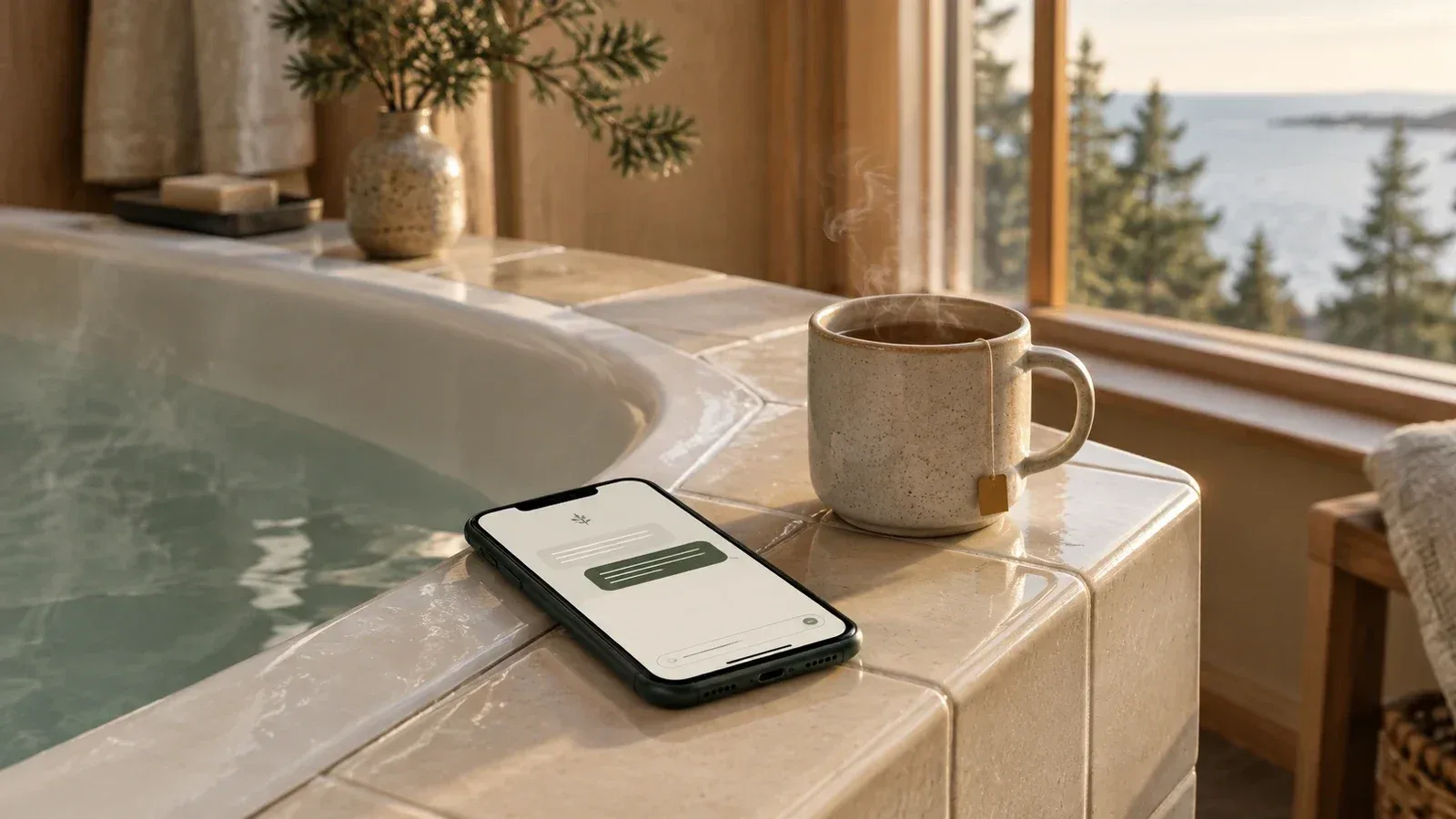
So I built myself a personal CRM a while ago, and the part I keep coming back to is where it happened: in the bathtub, on my phone, on a Thursday afternoon, with no laptop anywhere near. I described what I wanted, an agent built it, I looked at what came back and said what was wrong, and by the time the water went cold, it was running.
Yes, I know how that sounds. The reason I bring it up is that it’s the thing I keep tripping over when I think about how I work now, and it’s why this is the first of four posts on what I’ve started calling the personal OS. And if you decide what software a company runs, some of your people are probably already working like this.
Three places, no desk
Building the CRM is one of three things I’ve done away from a desk. My daily check-ins and check-outs (what I’m planning, what actually happened, what’s stuck) happen on the train now, typed with one thumb between stations. And the manifesto I’d been chewing on for months finally got written in the car, out loud, in a voice conversation that turned into a draft I could edit later.
None of these needed a desk or a particular laptop, let alone a particular operating system. What they needed was a way to say what I wanted, and a way to check what I got.
Describing the work
That’s the shift I didn’t see coming. For twenty-odd years, working meant sitting inside a document and pushing things around until it looked like the thing in my head. For me, and for more and more people I talk to, the work is now describing what done looks like, and then reviewing what comes back.
And how that’s done varies from person to person. Some of us aren’t stuck with Word or (god forbid) PowerPoint any more; we do it in whatever interface we feel comfortable with. Some people talk, some write long messy notes, and I mostly type into whatever’s closest. The document stopped being the format: you describe the work wherever you think best, and the output gets rendered from that.
The more data I pull in from other places (mail, calendar, notes, to-dos), the less I open a browser, or the apps all that stuff came with. These days the app is mostly where the data lives; it used to be the way in.
The shell is cracking
I’m not the only one routing around the software I was handed. This year’s been full of it, and October alone was quite something.
- On 19 October, TechCrunch wrote about people using AI to make their smart TVs dumb again. One project, Clean Your TV, was built with Claude Code and works with whichever coding agent you’ve got: it strips the bloat off Android and Google TV sets over Wi-Fi and puts a cleaner home screen on top. Its list of tested sets includes TCL and Philips. (Samsung and LG sets are out, since they don’t run Android. And it can brick your TV, which TechCrunch mentions too.) TechCrunch’s point was that coding agents put this kind of hacking within reach of people who’d never have tried it.
- Snapintosh, an open-source project Windows Central covered on 22 October, boots macOS 27 on an ASUS Zenbook A16 with a Snapdragon X2 chip. According to the repo you need a Mac to start it and there’s no sound yet, but the hackintosh was supposed to have died with the Intel Macs.
- People booted iOS on Android phones (Android Authority), and on Microsoft’s abandoned Surface Duo 2 (Windows Latest). Wi-Fi, sound and the camera often don’t work, but it boots anyway.
It started earlier in the year, though. In early January an expired Logitech developer certificate stopped Options+ and G Hub from launching on Macs (AppleInsider). Custom buttons and gestures stopped working until you found the patch and installed it by hand, because the app’s own updater couldn’t run either. The open-source answer, OpenLogi, talks to the mouse directly and doesn’t want an account. And someone rewired a Logitech MX Keys (a keyboard whose USB-C port only charges) with a small Teensy board, so it works over a cable. According to the project’s README, the chip inside has no USB, so no firmware update could ever make it a wired keyboard, which is why the fix had to be in the hardware.
And then there’s Omarchy, DHH’s opinionated Linux setup, which calls itself “the malleable OS for the age of agents”. Linux on the desktop was never sexy; he just made it so, and now people install it and bend it to their own taste.
The counterexample
Microsoft went the other way. On 10 November 2025 Pavan Davuluri, who runs Windows, posted that Windows was evolving into an “agentic OS”. He switched the replies off after 400-odd, mostly angry ones, and followed up with “We know we have work to do on the experience” (The Stack).
I’d bet a fair few of the people who were angry at Microsoft that week were wiring agents into their own setups at home. They don’t reject agents at all, only the ones installed at them on someone else’s schedule, inside a system they can’t change.
So what’s a personal OS?
The way I use the term, it’s your data, your automations, your agents and your rules, sitting on top of whatever operating system came with the hardware. You put it together yourself, from whatever tools fit. The vendor’s OS doesn’t go away; it gets demoted to a driver layer, the bit that talks to the screen and the Wi-Fi.
For me that’s a bunch of small MCP servers connecting my notes, calendar, mail and to-dos to the agents I use, plus a lot of plain text. For someone else it’ll look completely different. Part three looks at what this means for the people buying software for a company, and part four asks whether wiring all that into agents is a good idea.
Something about all this feels familiar, though. Computing has swung between someone else’s machine and your own a few times now, and I think we’re in the middle of another swing. Part two, We’ve been here before, looks at those earlier swings, starting with the terminal.
Sources
- TechCrunch, People are using AI to make their smart TVs dumb again, 19 October 2026
- Clean Your TV on GitHub, accessed October 2026
- Windows Central, Hackintosh on ARM is absolutely possible, 22 October 2026
- Snapintosh on GitHub, accessed October 2026
- Android Authority, You can now run iOS on Android phones, 21 October 2026
- Windows Latest, iOS 26 on the Surface Duo, 27 October 2026
- AppleInsider, macOS certificate expiration broke Logitech’s mouse software, 7 January 2026
- heise, OpenLogi: Alternative to problematic Options app for Mac, 10 June 2026
- logitech-mx-keys-wired on GitHub, accessed October 2026
- Omarchy, accessed October 2026
- The Stack, “We have work to do,” admits Windows president after agentic fury, 17 November 2025
MAKE YOUR CASE.
If this poked at something you're building: talk to me.