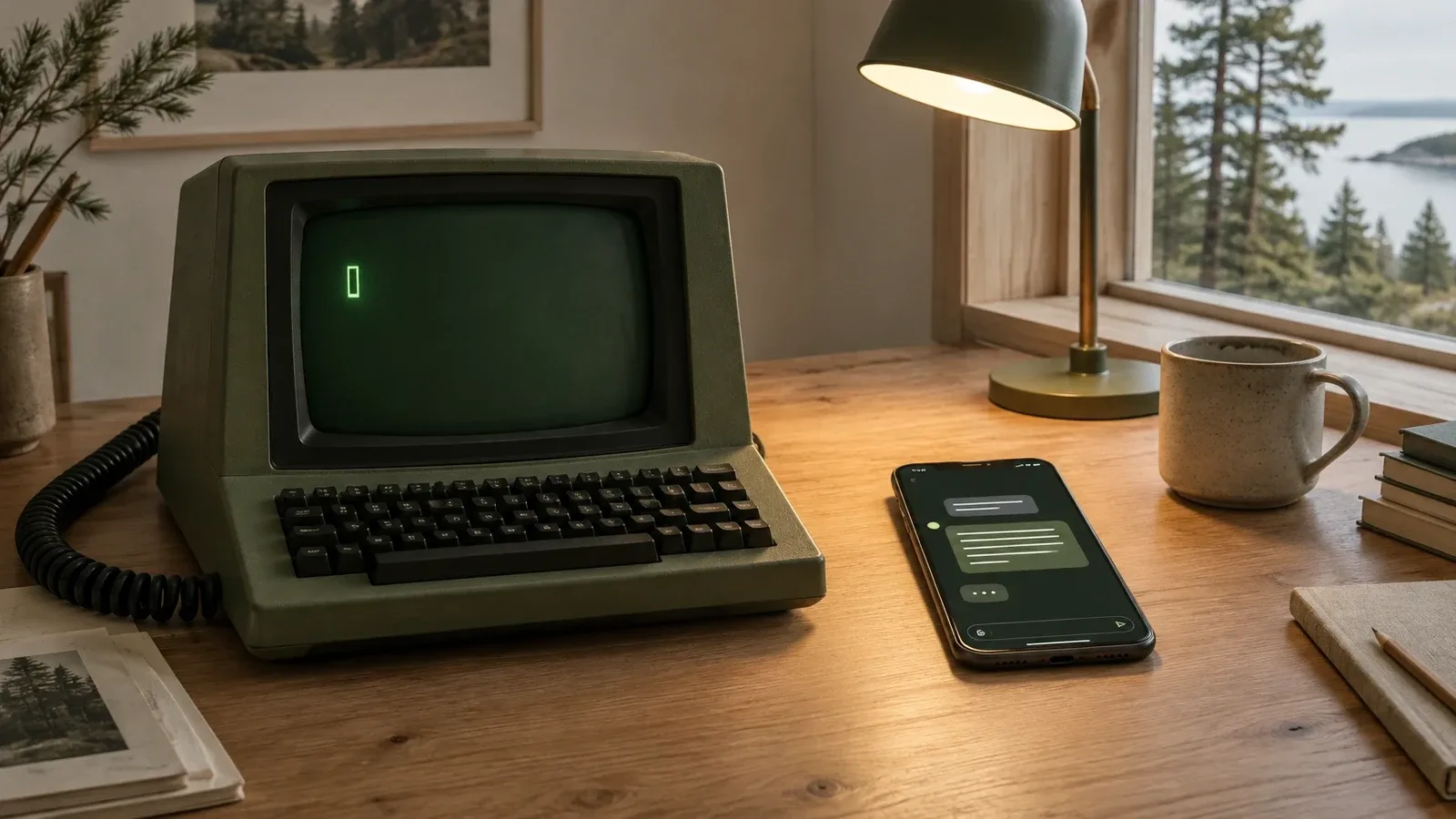
Last week ended with a promise to go back to the earlier swings, starting with the terminal, so that’s where this one starts.
In the mid-1960s, if you wanted to compute something, you mostly didn’t own the computer. You sat at a terminal - a keyboard and a printer, later a screen - wired to a mainframe somewhere else, and you shared that mainframe with a lot of other people. Time-sharing cut its attention into slices so everyone got a turn, and companies sold that time by the minute. The terminal couldn’t do anything on its own. All the thinking happened in the centre, and the centre decided what you were allowed to run.
In June 2025 Andrej Karpathy gave a talk where he compared working with LLMs to computing in the 1960s: the model is the expensive machine in the cloud, and we’re all on thin clients, sharing it.
The wheel
In 1968 two engineers, T. H. Myer and Ivan Sutherland, wrote a paper on display processors. They noticed that every time they moved a job out of the main computer into a separate graphics unit, that unit grew, got its own memory and its own instructions, until it was a full computer, and then the next job got moved out of that. They called it the wheel of reincarnation.
I think organisations run the same loop, just slower. Work moves out of the centre to wherever people can actually get it done, it grows up there, and then the centre folds it back in, usually with a bill attached.
The swings
So I made a list of every time computing swung between someone else’s machine and your own, since about 1965. It’s rough (historians will find things to argue with, and feel free to), but the pattern was clearer than I expected.
- 1965CentreTime-sharing. You rent minutes on someone else's mainframe, through a terminal that can't do anything on its own.
- 1977HomePersonal computers. The Apple II, the Commodore PET and the TRS-80 put a whole machine on your desk.
- 1979HomeVisiCalc. A spreadsheet on an Apple II lets people do their own sums without the data-processing department.
- 1995CentreThe Network Computer. Oracle's Larry Ellison pitches a cheap box without a hard drive that runs everything from the server. It never takes off.
- 2000CentreSaaS. Salesforce launches as 'The End of Software': your tools move onto someone else's servers, rented per seat.
- 2007CentreThe iPhone. A computer in your pocket, and a year later an App Store that decides what may run on it.
- 2011HomeBring your own device. People carry their own phones and laptops into work, and IT has to make room for them.
- 2019HomeLocal-first. "You own your data, in spite of the cloud."
- 2023CentreCloud LLMs. Intelligence as a metered service, and Andrej Karpathy describing the model as a new kind of operating system.
- 2024HomeMCP and bring your own AI. An open protocol to plug models into your own tools, and 78% of AI users bringing their own AI to work.
- 2026HomeThe personal OS. Agents in a terminal again, only now they work on your machine, with your data.
The VisiCalc row is my favourite. It came out for the Apple II on 17 October 1979, and a lot of people bought an Apple II only to run it. Plenty of those ended up in offices, often without going through the data-processing department. Spreadsheets became the backbone of finance that way, from the outside in.
Then the centre came back. Around 1995 Larry Ellison started pitching the Network Computer: a cheap box without a hard drive that loaded everything from a server. It never took off the way Ellison predicted. Five years later Salesforce launched with its ‘End of Software’ campaign, and within ten years a lot of our work tools ran from a server anyway, only now it was in a browser and we paid per seat. Ellison was about ten years early.
The iPhone is the swing I find hardest to place. It put a real computer in everyone’s pocket, which sounds like the home side, but from 2008 the App Store decided what could run on it. That’s a terminal with a very nice screen. And then people brought those phones to work, and IT had to make room for them, which pushed it back the other way.
In 2019 Ink & Switch published Local-first software, with the subtitle “You own your data, in spite of the cloud”. A lot of this series rests on that essay. Geoffrey Litt took it further in 2023 and wrote about malleable software in the age of LLMs: you use a tool, and when it hits a limit, you ask the AI to change it. Maggie Appleton calls the same thing home-cooked software, made by and for a handful of people.
What surprised me making the list is that neither side ever wins for good. A swing towards the person seems to start when people can do something on their own machine that the central one won’t let them do. It ends when the centre absorbs it and sells it back.
The vendor is a terminal too
The terminal was never only the hardware, though. Whoever sells you the machine and decides what it may do is a terminal as well, and you happen to own this one.
That’s what the TV people in part 1 were really fixing, and the mouse software that stopped launching because a certificate expired. The hardware was theirs, the rules weren’t.
Look at Apple from that angle. In June 2024 it announced Apple Intelligence, with on-device processing as its cornerstone and Apple’s own servers for the rest (plus a ChatGPT hook-up for some questions). I don’t know Apple’s roadmap and I’m not guessing at it. But the incentive is easy to see: if the layer where people do their work belongs to a model company, the iPhone turns into the driver underneath it. Putting the model on the device is one way to keep that layer.
What’s different this time
Most earlier swings to the person were about hardware. You got your own processor, then your own disk, then your own phone.
This time the abstraction is language. When the interface is a description of what you want, it matters less whose chip runs it. What you need to own is the intent (what you asked for and why), the data it works on, and the glue between your tools. That glue got a standard in November 2024, when Anthropic open-sourced the Model Context Protocol. It’s how my notes, calendar and to-dos talk to the model I use, and the model behind them could be swapped without rewiring the rest.
And people aren’t waiting for permission. Microsoft and LinkedIn’s 2024 Work Trend Index found that 78% of AI users bring their own AI tools to work, which Microsoft framed as a data risk. That’s the VisiCalc row all over again, only with a chat window instead of an Apple II.
The centre comes back
If the list shows anything, it’s that the centre always comes back. Usually it comes back carrying the things the home side was bad at: backups, audit trails, someone to call when it breaks, a way to make sure the numbers in the spreadsheet are right. That’s governance, and most of the swings back happened because people actually needed it.
So I don’t think the personal OS is the end of the line. Somewhere a company is already working out how to take what its people built with agents at home and fold it back in. Whether they do that well, or by banning it first, is what part 3 is about.
Sources
- Wikipedia, Time-sharing, accessed November 2026
- Andrej Karpathy, Software Is Changing (Again), Y Combinator AI Startup School, June 2025
- Andrej Karpathy, Intro to Large Language Models (the ‘LLM OS’), November 2023
- T. H. Myer and I. E. Sutherland, On the Design of Display Processors, Communications of the ACM 11(6), June 1968
- The Jargon File, wheel of reincarnation, accessed November 2026
- Wikipedia, VisiCalc, accessed November 2026
- Wikipedia, Network Computer, accessed November 2026
- Salesforce, The history of Salesforce, accessed November 2026
- Wikipedia, App Store (Apple), accessed November 2026
- Ink & Switch, Local-first software: You own your data, in spite of the cloud, 2019
- Geoffrey Litt, Malleable software in the age of LLMs, 25 March 2023
- Maggie Appleton, Home-cooked software and barefoot developers, 2024
- Apple, Introducing Apple Intelligence, 10 June 2024
- Anthropic, Introducing the Model Context Protocol, 25 November 2024
- Microsoft, 2024 Work Trend Index, 8 May 2024
If this poked at something you're building: talk to me.
MAKE YOUR CASE.